


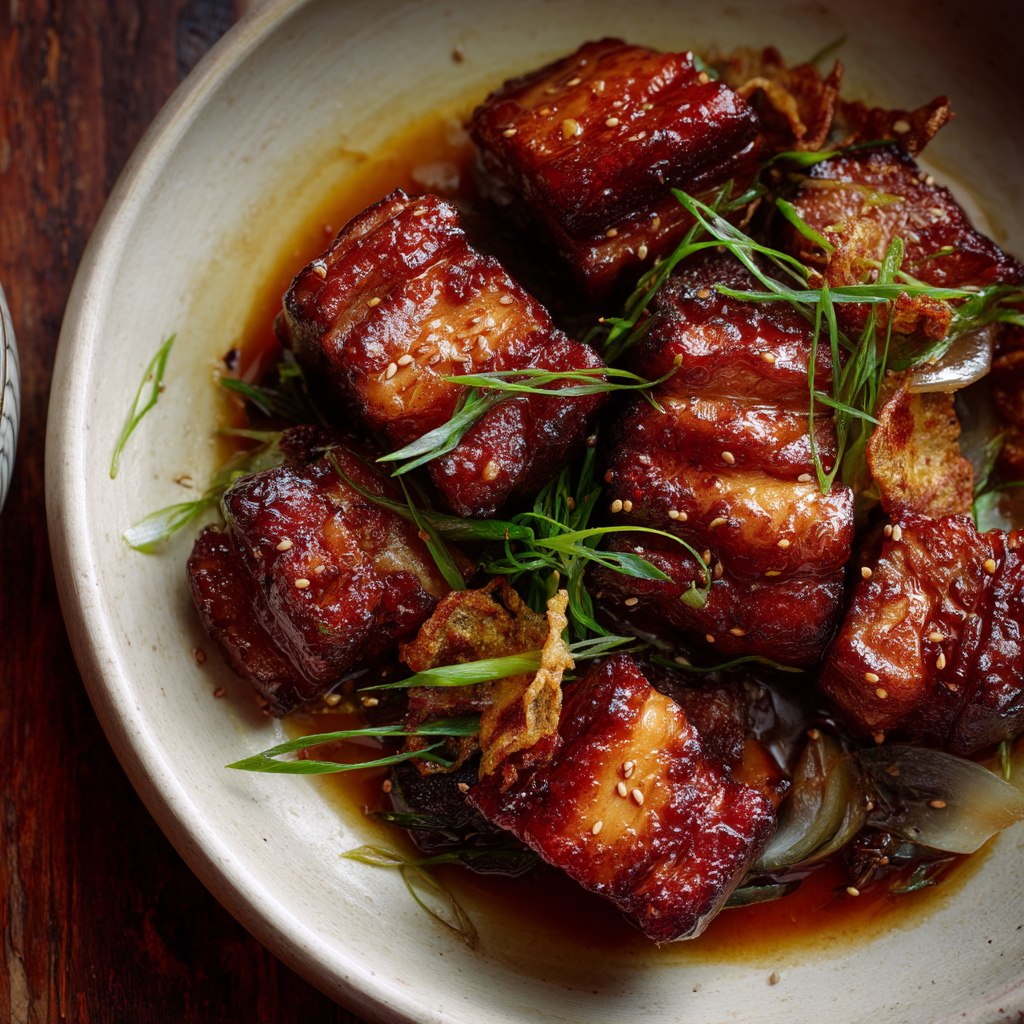
Korean Braised Pork Belly with Ginger-Soy Glaze
Recipe Overview
Dish Name: Korean Braised Pork Belly with Ginger-Soy Glaze and Crispy Garlic Cuisine: Korean | Category: Meat Course | Serves: 4 Prep Time: 25 minutes | Cook Time: 90 minutes | Total Time: 115 minutes
Why This Works
This Korean braised pork belly delivers what you’re actually craving when comfort food calls: meat so tender it splits with a spoon, glazed with a concentrated sweet-savory sauce that coats every bite. Unlike the standard BBQ cuts or the stew-based canonical dishes, this uses a two-stage braising technique borrowed from traditional Korean jorim methods but applied to thick pork belly pieces. First, we render the fat slowly in aromatics, then braise in a ginger-forward soy base that cuts the richness. The final step—a quick pan reduction topped with shatteringly crisp garlic chips—creates textural contrast you won’t find in typical braised preparations. It’s restaurant-quality depth with straightforward home kitchen execution, and it feeds four hungry people with minimal hands-on time.
Ingredients (Serves 4)
For the Pork:
- 1200g pork belly, skin removed, cut into 5cm x 8cm pieces (approximately 2cm thick)
- 2 tablespoons neutral oil
- 6 garlic cloves, smashed
- 60g fresh ginger, sliced into coins
- 3 spring onions, cut into 5cm lengths, whites and greens separated
- 500ml water
For the Braising Liquid:
- 120ml Korean soy sauce (jin ganjang preferred)
- 80ml mirin
- 60ml rice wine (cheongju or shaoxing)
- 2 tablespoons white sugar
- 1 tablespoon toasted sesame oil
- 1 Korean pear or Granny Smith apple, peeled and roughly chopped
- 10g dried shiitake mushrooms, roughly broken
- 1 teaspoon whole black peppercorns
For the Crispy Garlic Finish:
- 8 garlic cloves, sliced paper-thin on a mandoline
- 3 tablespoons neutral oil
- 1 tablespoon toasted sesame seeds
- 2 spring onions, green parts only, thinly sliced on the bias
Method
Mise en Place (25 minutes)
Cut pork into uniform pieces—consistency matters here for even cooking. Prep all aromatics because once you start, the sequence moves quickly. You need a heavy-bottomed Dutch oven or braiser with a lid, a spider or slotted spoon for the garlic chips, and a wide shallow serving dish. Have a fine-mesh strainer ready for the braising liquid.
Initial Searing and Fat Rendering (20 minutes)
Heat the neutral oil in your Dutch oven over medium-high until it shimmers. Working in batches to avoid crowding, sear the pork belly pieces fat-side down first, about 4 minutes until deeply golden. Flip and sear the meat side for 3 minutes. Remove and set aside. This isn’t about cooking through—you’re building flavor foundations and rendering enough fat to create the right mouthfeel later.
Aromatics Foundation (5 minutes)
Pour off all but 2 tablespoons of fat from the pot. Drop the heat to medium. Add the smashed garlic, ginger coins, and spring onion whites. Cook, stirring frequently, until fragrant and the garlic edges turn golden, about 3 minutes. The ginger should smell sharp and clean, not burned. This aromatic base infuses the entire braise, so don’t rush it.
Building the Braising Liquid (5 minutes)
Return the pork to the pot, arranging pieces in a single layer if possible. Add the soy sauce, mirin, rice wine, sugar, sesame oil, chopped pear, dried shiitake, and peppercorns. Pour in the water—it should come halfway up the pork, not submerge it. The pear breaks down during cooking and adds natural sweetness while tenderizing the meat through enzymatic action. Bring to a vigorous boil over high heat.
Low and Slow Braise (60 minutes)
Once boiling, reduce heat to the lowest simmer you can achieve. Cover with the lid slightly ajar—about 2cm gap. You want gentle bubbles breaking the surface every few seconds, not a rolling boil. Braise for 45 minutes, then flip the pieces carefully and continue for another 15 minutes. The pork should yield easily to a fork but still hold its shape. If it’s tough, give it another 10 minutes. Total braising time varies with pork thickness and your stove’s actual temperature.
Reducing the Glaze (15 minutes)
Remove the pork pieces to a plate and tent loosely with foil. Strain the braising liquid through your fine-mesh strainer into a clean saucepan, pressing on the solids to extract every drop. Discard the solids. Bring the liquid to a hard boil over high heat and reduce by two-thirds, stirring occasionally, until it coats the back of a spoon and has a glossy, syrupy consistency. This concentrates the flavors dramatically—it should taste intensely savory-sweet.
Crispy Garlic Chips (8 minutes)
While the glaze reduces, heat the 3 tablespoons of neutral oil in a small saucepan over medium-low heat. Add the sliced garlic all at once. Stir constantly as it cooks. The garlic will slowly turn from white to pale gold to deep amber—this takes about 6 minutes. Watch it closely in the final 2 minutes; it goes from perfect to burnt in seconds. When deeply golden and crisp, immediately remove with a spider to paper towels. It will continue cooking slightly from residual heat and crisp up further as it cools.
Final Assembly (2 minutes)
Return the pork to the reduced glaze and turn each piece to coat thoroughly. Transfer to your serving dish, pour any remaining glaze over the top, and scatter with the crispy garlic chips, sesame seeds, and sliced spring onion greens. Serve immediately while the garlic is still crisp and the pork is hot.
What You Need to Know
The pear isn’t optional. Korean pears contain calpain enzymes that actively tenderize meat during cooking. If you substitute with apple, use a tart variety—the acidity and pectin content work similarly, though slightly less effectively.
Temperature control during braising is critical. Too high and the pork seizes up, becoming dry and stringy despite the liquid. You want that barely-simmering sweet spot where collagen converts to gelatin slowly, creating the melt-in-your-mouth texture. If you don’t trust your stove’s lowest setting, use a 150°C oven instead—more consistent heat distribution.
The glaze reduction step transforms the dish. Underreduce and you have watery sauce that slides off the meat. Overreduce and it becomes cloying and sticky. The correct consistency looks like maple syrup at room temperature and should ribbon off your spoon in a continuous stream that holds its shape on the plate for 2-3 seconds before slowly spreading.
Make-ahead strategy: Braise the pork completely up to 2 days ahead. Cool in the strained liquid, refrigerate, then reheat gently before reducing the glaze. The flavors actually improve with time. Make the garlic chips the day of serving—they lose crispness quickly in humid conditions.
The Result
The pork belly should pull apart with minimal resistance, each piece glossy with a lacquered finish that catches the light. The fat has rendered to a silky, gelatinous texture without greasiness, while the meat itself stays tender and yielding. That first bite hits with concentrated umami depth from the shiitake and soy, tempered by ginger’s clean heat and the fruit’s gentle sweetness. The crispy garlic adds sharp pungency and crucial textural contrast against all that tender richness. The glaze should taste balanced—not overtly sweet, not one-dimensionally salty—with lingering warmth from the ginger and sesame. Serve it over steamed white rice that soaks up the extra glaze, with kimchi on the side to cut through the fat between bites.
Nutrition Information Based on a 2,000 Calorie Diet (Per Serving)
| Nutrient | Amount | % Daily Value |
|---|---|---|
| Calories | 685 kcal | 34% |
| Total Fat | 54g | 83% |
| Saturated Fat | 18g | 90% |
| Trans Fat | 0g | 0% |
| Cholesterol | 122mg | 41% |
| Sodium | 1,845mg | 80% |
| Total Carbohydrates | 21g | 8% |
| Dietary Fiber | 1g | 4% |
| Total Sugars | 14g | 28% |
| Protein | 28g | 56% |
| Vitamin D | 1.2mcg | 6% |
| Calcium | 48mg | 4% |
| Iron | 2.1mg | 12% |
| Potassium | 512mg | 11% |
Flavor Balance
Sweet (6/10): The Korean pear and mirin provide natural fruit sweetness, rounded out by white sugar in the braising liquid. The glaze reduction concentrates these elements without becoming cloying. The sweetness functions to balance the salt intensity and temper ginger’s heat.
Salty (8/10): Dominated by the soy sauce base, which provides not just sodium but fermented depth. The long braise followed by aggressive reduction concentrates the salt, requiring the fruit sweetness and sesame oil’s richness to keep it in check. This is intentionally high—it needs to season the fatty pork thoroughly.
Sour (3/10): Subtle acidity comes from the rice wine and natural fruit acids in the pear. Not a prominent note but necessary to prevent the dish from feeling heavy. The mirin adds mild acidity alongside its sweetness.
Bitter (2/10): Minimal presence, primarily from the toasted sesame oil and lightly caramelized edges of the garlic chips. The ginger provides mild bitter undertones that register as warmth rather than true bitterness.
Umami (9/10): This is where the dish lives. The soy sauce provides glutamates, the dried shiitake contributes guanylates, and the long braise extracts every molecule of savory depth from the pork itself. The reduction step concentrates all of these compounds into an intensely savory glaze. Sesame oil adds nutty, toasted umami notes that linger on the palate.
Wine Pairing
1. Technical Match
Weight: This is a full-bodied, rich dish with substantial fat content and intense flavors that demand a wine with equivalent weight and structure. Light wines disappear; you need something that can stand up to the pork’s fattiness and the glaze’s concentration without being overwhelmed.
Acid Balance: The dish registers moderate acidity from the rice wine and fruit components but leans heavily toward fat and umami. The wine needs substantial acidity (6.5-7.5g/L) to cut through the pork belly’s richness and refresh the palate between bites. Without adequate acid, the combination becomes heavy and monotonous.
Tannin Interaction: The high fat and protein content in pork belly can soften and integrate moderate tannins beautifully. You want enough tannin structure (medium to medium-plus) to provide grip and prevent the wine from tasting flabby against the rich meat, but not so much that it turns astringent against the sweet-savory glaze. Silky, resolved tannins work better than aggressive, grippy ones.
Serving Temperature: 16-18°C is ideal. Too cold and you mute the wine’s aromatic complexity and make the tannins feel harder; too warm and the alcohol becomes prominent and clashes with the dish’s umami intensity.
2. Flavor Architecture
Primary Bridge: The ginger and sesame elements in the dish mirror the peppery, spicy notes found in many Australian Shiraz expressions. Both share warm, aromatic compounds (particularly gingerol in ginger and rotundone in Shiraz) that create seamless integration. The toasted sesame oil’s nuttiness also bridges to wine matured in oak.
Complementary Elements: The wine’s dark fruit concentration (plum, blackberry) provides contrast to the savory-dominated dish while the meat’s rendered fat softens any tannic edges. Shiraz’s characteristic black pepper and spice notes complement the ginger without competing, while subtle oak-derived vanilla and chocolate notes harmonize with the caramelized glaze.
Regional Logic: While not a traditional pairing geographically, the principle follows classic meat-and-bold-red logic. Korean cuisine’s increasing embrace of wine pairings has shown that structured reds work exceptionally well with ganjang-based braises, particularly when ginger features prominently.
Common Mistakes: Avoid high-alcohol fruit bombs (15%+ ABV) that taste hot and jammy against the glaze’s sweetness. Skip delicate Pinot Noirs—they’re completely overwhelmed. Tannic monsters like Barossa Shiraz aged in 100% new oak turn astringent against the soy sauce’s salinity. Avoid oaked Chardonnay despite the temptation—the buttery richness on richness becomes cloying without enough acid structure.
3. Recommendations with Scoring
Primary Pairing: McLaren Vale Grenache-Shiraz Blend (60/40 or 70/30)
- Intensity Match: 9/10
- Flavor Harmony: 9/10
- Texture Interaction: 8/10
Why: This blend delivers the best of both varieties. Grenache contributes bright red fruit, moderate alcohol, and supple tannins that don’t fight the glaze’s sweetness. Shiraz adds structure, pepperiness, and dark fruit depth that bridges to the ginger and soy. McLaren Vale’s Mediterranean climate produces wines with natural balance—ripe fruit without excessive alcohol, enough acidity to stay fresh, and resolved tannins from warm-climate ripeness. The blend’s medium-full body matches the pork’s richness without overwhelming the nuanced aromatics from the braising liquid.
Specific Producers: d’Arenberg “The Custodian” Grenache, Yangarra Estate Grenache (if you can find the Shiraz blend variant), Bekkers “Syrah Grenache”
Alternative 1: Heathcote Shiraz
- Intensity Match: 8/10
- Flavor Harmony: 8/10
- Texture Interaction: 9/10
Why: Heathcote produces Shiraz with distinctive savory, peppery character and firm but fine-grained tannins thanks to the region’s ancient Cambrian soils. These wines show more restraint than Barossa—less fruit-forward, more structured and mineral. The inherent pepperiness mirrors the ginger perfectly, while moderate alcohol (13.5-14.5%) prevents the wine from tasting hot against the sweet glaze. The tannin structure is ideal for the fatty pork, providing grip without astringency.
Specific Producers: Jasper Hill “Georgia’s Paddock,” Wild Duck Creek “Duck Muck” (if you want more intensity), Tellurian “Tranter” Shiraz
Alternative 2: Yarra Valley Pinot Noir (Richer Style)
- Intensity Match: 6/10
- Flavor Harmony: 7/10
- Texture Interaction: 7/10
Why: This is the lighter-bodied option for those who find Shiraz too intense. Choose a riper, fuller-bodied Yarra Pinot with some whole-cluster fermentation for additional spice and structure. The wine’s earthy, mushroom-like characteristics complement the dried shiitake in the braise, while red fruit provides contrast to the dark, savory glaze. The lighter tannin structure means the pork’s fat doesn’t have as much to soften, but adequate acidity keeps the palate refreshed. This works better if you’ve trimmed more fat from your pork belly pieces.
Specific Producers: Yarra Yering “Pinot Noir,” Giant Steps “Sexton Vineyard” Pinot Noir, Mac Forbes “Woori Yallock” Pinot Noir
HACCP-Compliant Storage and Safety
Cooling Procedures
- Cool braised pork from 60°C to 21°C within 2 hours, then from 21°C to 5°C within an additional 4 hours (6-hour total cooling window)
- Spread pork pieces in a single layer on a clean sheet pan to accelerate cooling; do not stack
- Refrigerate uncovered until cooled below 21°C, then cover tightly to prevent contamination
- Never leave cooked pork at room temperature longer than 2 hours cumulative time
Refrigeration Guidelines
- Store braised pork in shallow, covered containers at 4°C or below
- Maximum refrigerated holding time: 3-4 days from cooking date
- Label containers with preparation date and contents
- Store on lower shelves below ready-to-eat foods to prevent cross-contamination
- Keep garlic chips separate in an airtight container at room temperature for up to 24 hours; they lose crispness in refrigeration
Freezing Guidelines
- Freeze braised pork in the strained braising liquid to prevent freezer burn
- Use freezer-safe containers or heavy-duty freezer bags, removing excess air
- Maximum frozen storage: 2-3 months at -18°C or below
- Label with contents and freeze date
- Do not freeze crispy garlic chips; prepare fresh when serving
Reheating Procedures
- Reheat pork to an internal temperature of 74°C, verified with a calibrated probe thermometer
- Stovetop method: Heat covered over medium-low for 12-15 minutes, turning pieces once, until 74°C throughout
- Oven method: Reheat covered at 165°C for 20-25 minutes until internal temperature reaches 74°C
- Microwave reheating not recommended (uneven heating creates food safety risks)
- Bring braising liquid/glaze to a rolling boil before coating reheated pork
- Consume reheated pork immediately; do not reheat more than once
Disposal Guidance
- Discard any pork held at room temperature longer than 2 hours
- Discard refrigerated pork after 4 days regardless of appearance or smell
- Discard frozen pork showing signs of freezer burn, ice crystal formation, or off-odors after thawing
- When in doubt, throw it out; do not taste suspect food to determine safety
